
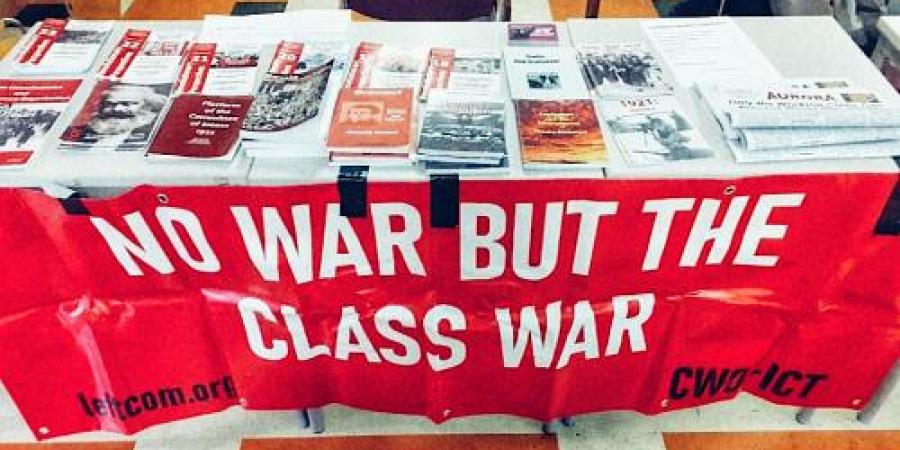
Between the months of January and March 2024, CWO comrades held three public meetings (in Manchester, London and Birmingham) and gave presentations at two other events (an NWBCW Liverpool public meeting and the Sheffield Radical Bookfair). In recognition of the seriousness of the world situation, the topic of discussion at each of these meetings was centred around the drive to war, the meaning of internationalism, and the tasks of revolutionaries.
The Presentations
A number of different presentations were prepared for the meetings, each emphasising a slightly different angle of the question. Instead of reproducing them all, the essence of the message we tried to put forward can be summarised as follows.
Russia’s invasion of Ukraine on 24 February 2022 marked an important step on the road to global conflict. As in any war, the main victims have been workers, whether in uniform or civilians; perhaps half a million dead and injured, millions displaced, fleeing both the war and conscription.
The last few months have seen the war in Gaza, which erupted on 7 October 2023, eclipse the situation in Ukraine in the world’s media – as it stands, more than 30,000 are dead on the Palestinian side, including more than 10,000 children, in response to a Hamas offensive that left around 1,200 dead Israelis and some foreign nationals.
Both wars are the products of decades-long disputes where there is no end in sight. There can be no peace, only pauses for exhaustion, and preparation for later resumption of conflict.
These wars are a symptom of a system in crisis. For 50 years, since the post-war boom came to an end, the ruling class has been trying various tactics to reverse declining growth rates, with no great success. They have increased the exploitation of workers worldwide, moved production to low-wage economies, deregulated financial institutions to engage in reckless speculation, and piled up debt for future generations.
None of it has resolved the underlying problem and now the competing ruling classes are forced to adopt more direct methods to gain advantage over their rivals. The result is an intensification of rivalry leading to increased military tensions. The wars in the news may be between Russia and Ukraine, Israel and Palestine, but worldwide the main imperialist rivalry brewing is between the US and China.
China is vying to be the premier economic power by 2049 – the centenary of the foundation of the People’s Republic – while the US is not going to give up its pre-eminent position without a fight. Like Gaza, like Ukraine, there is no room for compromise here either. The US has made no secret recently that it sees China as its main rival. Even when discussing the war in Ukraine, the US attacks China as much as Russia; and while China seeks to play the peacemaker in Ukraine, it condemns the US for ‘interfering’ in Taiwan, which it still regards as a rebellious province.
The war in Ukraine has already reinforced the strategic divide in the world. For 35 years, the US and its allies have used sanctions against their enemies, such as Russia, China and Iran. This has brought these three into an anti-American alliance of convenience that has become closer in the last two years.
On the other side, the US has been able to discipline wayward NATO members like Germany, and the war has provoked Finland and Sweden to join NATO, even if some NATO members, such as Turkey and Hungary, have dragged their feet.
Other states have tried to steer a course which has avoided inconvenient imperialist entanglements. No countries in Africa or South America have joined the western sanctions regime, and South Africa has taken a lead in condemning Israel over the Gaza war. American superiority has taken a knock with the disastrous consequences of its involvements in Iraq and Afghanistan; India has been aiding Russia by buying its oil, as has Saudi Arabia, one of the US’s most important allies in the Middle East.
A global arms race has begun – 2022 saw the biggest annual rise in global arms spending since the Second World War. Both world wars of the twentieth century were preceded by similar races to rearm.
There has also been a drive for food and energy security, as well as a scramble for vital raw materials. These moves both increase instability and, at the same time, destroy any chance that capitalism could even begin to tackle the problem of climate change.
The situation in recent months has worsened considerably. The slaughter in Gaza has been accompanied by an increased military presence in the region by the US and other NATO countries; even China has sent warships.
The war has spread to Yemen, where the de facto – though not universally recognised – government of the Houthi militia is backed by Iran. The Houthis have attacked shipping in the Red Sea in support of the Palestinians, and has also sent missiles and drones towards Israel. In response, the US and UK have bombed Yemen. In the short- to medium-term, closure of the Red Sea and Suez Canal as commercial shipping lines seek a less dangerous route looks likely to cause inflation in Europe, which will of course continue to hit the working class hardest.
In this situation of increased tension, some voices have been calling for conscription to be re-introduced in Britain, as well as echoing voices in Germany and other European countries which have scrapped it in recent decades.
But the working class has no interest in killing and dying for the profits of the capitalist class.
In both the First and Second World Wars, there were groups that stood against the tide of nationalism, who put forward the idea that the struggle against war was the struggle for socialism, and who worked towards that end. In that spirit, our political ancestors founded the Internationalist Communist Party in 1943, calling workers to “desert the war, desert it, under whatever mask it shows itself to you”.
It is hard to oppose the war once it has begun, especially if you are on your own. Survival is hard enough sometimes. We have to acknowledge those in Russia and Ukraine, Gaza and Israel, who have already deserted, sabotaged and refused to fight. However, while we give vocal support to all sorts of refuseniks, we have to say that individual acts based on pacifism, liberalism and humanitarianism are not enough. Sympathy for the victims of war does no remove the causes of the war, and individual actions, no matter how heroic, self-sacrificing or desperate – and we could mention the cases of young Israelis who have been sent to prison for refusing to be conscripted into the IDF, or the protest-suicide of a young American airman who “refused to take part in genocide” – will not stop the war machine.
Workers must reject all national causes. They exist to bind us to our oppressors and separate us from our class siblings. We must find ways to unite on the basis of class, not nation, race or religion.
For our part in the Internationalist Communist Tendency (ICT), we have supported the creation of No War but the Class War (NWBCW) committees as an attempt to bring the revolutionary alternative to the working class – to link the attacks the class is suffering worldwide to the ongoing crisis of capitalism and to put forward the revolutionary perspective – world revolution against a capitalist system threatening the future of humanity.
The Discussions
Generally, our views found a receptive audience and the discussion during each of the meetings took a comradely form. Among the attendees we noted members of the International Communist Current (ICC), the International Communist Party - _Il Partito Comunista_ (ICP), the Anarchist Communist Group (ACG), the Revolutionary Anarchist Group (RAG), the Solidarity Federation (SF), the Socialist Party of Great Britain (SPGB), and the Old Moles Collective, as well as many individuals not currently part of any organisation. The AnarCom Network (ACN) sent their apologies for not being able to make it this time. Naturally, certain disagreements arose during the discussions, and it is worth focusing on some of them here, since they are indicative of wider trends.
In Manchester, the main disagreement came from the comrades of the ICC. While they endorsed the presentation (only questioning some of the terminology), they objected to the idea of NWBCW. We were told only the Communist Left represents genuine internationalism and it is a mistake to partake in an initiative with "leftists and anarchists". Of course, we agree that the Communist Left, the tendency to which we belong, has the clearest view on the question – as demonstrated by the confusion that arose within all the other tendencies claiming to be revolutionary when faced with war. But that doesn't mean the Communist Left alone has a monopoly on internationalism – as also demonstrated by various groups and individuals from outside the Communist Left who have arrived at similar conclusions to us. The NWBCW initiative recognises this, and in response to the seriousness of the world situation, calls for all genuine internationalists to work together by bringing an alternative message to the wider working class (not just by signing statements, but where possible through active intervention in the class struggle). The initiative never closed itself off to potential involvement of the ICC, but it does actually aim to exclude "leftists", whether they consider themselves "communists" or "anarchists", because as we have shown in our own publications, behind their ostensibly "internationalist" proclamations hides support for one of the warring factions or at best a "part-time internationalism".
In Liverpool, the main disagreement came from a trade union activist who, while agreeing with the presentation in principle, argued that in the absence of a real working class movement, we are nevertheless forced to pick the "lesser-evil". In practice however, this position translates to defencism, or as Rosa Luxemburg once put it: "proletarians of all countries, unite in peace-time and cut each other’s throats in war". The task of revolutionaries is to preserve the internationalist message, no matter how unpopular it may be in the immediate term, because eventually, as the war takes its toll on the working class, they may look for an alternative to the capitalist system that has produced such misery and bloodshed. The absence of a real working class movement that could influence the course of events is of course the biggest obstacle we face – but giving up on internationalism in the face of war will not help such a movement come about.
In London, it was a couple of young students (possibly from a Trotskyist background) who defended the idea of self-determination as a "transitional demand". Throughout history we have seen countless examples of national movements for self-determination, some successful others less so, the aftermath of which has neither strengthened the working class movement nor has it banished the nationalist poison. In fact, often it has done the exact opposite, creating an environment very difficult for internationalist groups to work in. At the end of the day, like all "transitional demands", even critical support for self-determination means support for the capitalist faction which attempts to carry it out. The ICC, who were also present, argued that our perspective was wrong and overly alarmist since world war could not happen in the near future as blocs did not exist and the "undefeated" European working class could not be mobilised for a war. However, this long held assertion of the ICC fails to explain how in the war in Ukraine, despite all the desertions, hundreds of thousands of workers have nevertheless been mobilised (through conscription and the war economy) for the conflict to keep going. Furthermore, a member of the Old Moles Collective pointed out that blocs need not be fully formed for war to break out, as occurred at the start of the Second World War.
In Birmingham we faced no disagreements when it came to internationalism, though some questioned whether the falling rate of profit is the motive force behind the drive to war. However, our insistence on economic analysis helps to understand that what’s currently happening is not the result of irrationality, the madness of certain world leaders, etc. but that it is the workings of the capitalist system itself which create the conditions for generalised conflict. This does not mean that individual capitalists are all secretly hoping for war to eventually bring about the next economic upsurge (though some probably are!), but it does mean that low profitability leads to fiercer competition, where the adoption of desperate military measures is more likely. The other aspect of the presentation which came under question was around what world war would actually look like and whether that’s where we’re heading. It was pointed out that it’s a secondary issue whether the drive to war results in a direct clash between two or more superpowers or if we will see the steady proliferation of regional conflicts around the globe, as the consequences for humanity will be dire either way.
In Sheffield, we heard a contribution from a teacher who, while initially finding our position on the war in Ukraine refreshing, said that the longer that it goes on, the more difficult it becomes to imagine the possibility of any outcome that's not simply the victory of one or the other side (in which case, they'd consider a Ukrainian victory to be the "lesser-evil"). The participant brought up a dispiriting example from their work life, where some of the Ukrainian kids that they teach now greet each other with the nationalist salute "Slava Ukraini". We could only reiterate that reneging on internationalism when it's unpopular gets us no closer to a different society which could truly put an end to war. Internationalists have to say what only internationalists can say, otherwise other workers who begin to recognise the current system offers no solution will have no reference point to draw on. The roots of the current war in Ukraine go back not only to the collapse of the USSR, but to the days of the Russian Empire. A temporary settlement might be arrived at eventually, but the conflict doesn't just end there, it only opens a new chapter. It is the framework of capitalism itself, which divides humanity into nation states which compete for profits, markets, resources and territory, that ensures war and nationalism will continue to thrive while millions suffer.
The Prospects
In the immediate term, we can expect workers everywhere will be asked to make more and more sacrifices for the state and nation. The resistance put up so far has largely remained within the strait-jacket of the unions, which only negotiate the sale of workers' labour but do not question it. Among all the current waving of national flags, there is no doubt that internationalists are swimming against the current. But the fact that strikes and protests are happening at least provides internationalists with a pond to swim in. Furthermore, over the past few years we have seen a new generation of workers arrive at internationalist conclusions – despite decades of class retreat, the torch is being passed on. If nothing else, the experience of this series of meetings, with new contacts emerging and old ones resurfacing, speaks to the fact that now is not the time to despair or retreat into isolation.
-- Communist Workers’ Organisation _
18 March 2024