
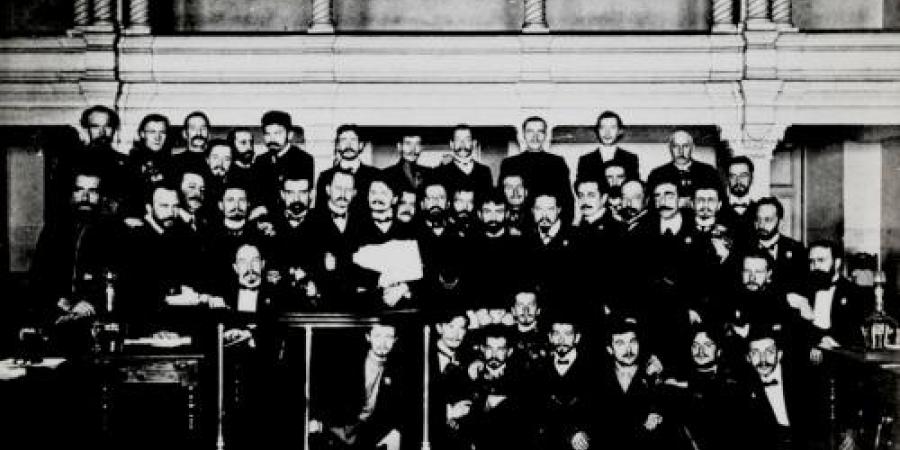
(The "Workers' Government" of the St Petersburg Soviet)
Introduction
The first part of this article (https://www.leftcom.org/en/articles/2025-01-08/a-majestic-prologue-the-…) had two aims. The first was to give today's readers the context in which they could understand the 1905 revolution from the perspectives of today. The second was to examine the origins of the 1905 movement. The key point here was to demonstrate how such waves of struggle can begin with either very limited aims or within the institutional constraints imposed by a reactionary regime fighting for its life. Since we published Revolutionary Perspectives 34, we have had the opportunity to read what others who claim to be revolutionary and socialist have written. Largely they have confined themselves to analyses repeating long passages of what Lenin, Trotsky or Luxemburg wrote about the year 1905. This is more than a pity as it appears to be an opportunity lost. Despite the enormous contributions of all three revolutionaries (and we ourselves extensively quote their analyses where appropriate), they were writing in a different epoch and not addressing the concerns of our own time. They did not have to present the issue to a proletarian audience which had seen the political degeneration of the Stalinist counter-revolution (1) and the creation of a monstrous party-state apparatus which was the very opposite of the kind of society envisaged by all the supporters of scientific socialism. The lie that Stalinism was socialism is still a living one today. The current dictatorship of the bourgeoisie posing as representative democracy can only draw its own right to rule from that lie. Today, some of the best elements of the younger generation fear all forms of a conscious and permanent proletarian political organisation as a consequence. A review of what actually happened in the 1905 Revolution is an excellent way to tackle this issue since it raises all the issues about spontaneity and the relationship between parties (revolutionary minorities) and the organs of struggle created for the entire working class. Despite the ultimate failure of the Soviet in 1905 it does raise all the difficult questions about the nature of revolutionary class consciousness can develop and how a mass proletarian revolution can take place.
January and February 1905
In the first part of this article we confined ourselves to an analysis of the origins of the revolutionary movement of 1905 in Russia. In that article we underlined the messages that workers' revolutions can not only originate from the most unpromising beginnings, but that they can also sometimes appear to arrive out of nowhere. We say "appear" because that is how such events strike contemporaries. In reality, though we are not talking about something that is the result of chaos theory but the product of precise causes which may not be immediately apparent to the historical actors at the time but which can only be understood by taking in the whole picture in a historical way. It is scientific study and reflection which reveals the factors which help to explain why these historical events occurred this way and not any other. And this is the lifeblood of any revolutionary discussion for today.
In the context of 1905, this brings us directly to a discussion of the questions of spontaneity and self-organisation and to relationship between political parties and class-wide organs. The great general strike which broke out in January 1905 was as spontaneous as that term could be understood but, as we demonstrated in the first part, the preparation for it had long been coming in the series of strikes that had broken out at frequent intervals since 1896. It was a process which was quite quickly leading to the formation of the proletariat in Russia not just as a class but a class with a common consciousness. Ironically, the declaration of war against Japan in the summer of 1904 had led to a wave of patriotism (as Plehve, the Minister of the Interior, had hoped) which, alongside the split at the 1903 Congress, ensured that the Social Democratic factions (Bolshevik and Menshevik) fell to their lowest ebb of support on the eve of Bloody Sunday. Lenin complained to the St Petersburg Committee of the Bolsheviks in August 1904
"Everywhere there is a terrible lack of people... complete isolation, a general mood of depression and bitterness, stagnation as regards positive work. Ever since the Second Congress the party is being torn to pieces, and today, things have gone very far in this respect. (2)"
The Mensheviks were little better off having lost something like three quarters of their members in the working class districts of St Petersburg. (3) Thus, the organisations which encapsulated the growing class awareness of the working class in Russia were forced to run along behind events in the first two months of 1905. This confirms what Anweiler says about the early months of 1905.
"The strike movement beginning in 1905 did not rely on trades union or political organisations. Unions emerged only during the revolution and indeed because of the strikes, and the revolutionary parties were too limited in their scope. The strike movement was spontaneous in the true sense of the word - that is the strikes flared up out of some local incident or other, lasted for few days or at most weeks, and burned themselves out after certain concessions had been achieved or labour's resources were exhausted. (4)"
This is true. These strikes weren't the kind of formal one-day jobs called by unions today to demobilise struggles. They were manifestations of real class war. Workers had no other resources but themselves in these strikes and threat of starvation often led to their defeat. On the other hand the wave of strike after strike in these early months, involving 150 000 workers (i. e. more than in the whole decade previously), forced more concessions from the bosses than would have been won a few months earlier. As Rosa Luxemburg noted:
"The January strikes ended victoriously almost throughout. (5)"
She then spends the next two pages listing all the reductions in the working day (in some cases to ten hours, in others to nine - the "legal" day was 11 throughout the Russian Empire at that time) as well as wage increases. She also points that employers then tried to take these concessions back later in the year only to see the workers strike once again. The significance of January 22nd 1905 was that the Russian workers had gained extraordinary self-confidence in their ability to struggle. As we showed in the first part this new self-organisation was largely based on the transformation of institutions which Tsarism had tried to impose on the workers to control their struggles.
Another strength of the movement was that the state did not have organs of mass media to spread lies about what was happening. Proclamations threatening that demonstrators would be shot posted on walls by General Trepov (governor of St. Petersburg) or attacks on demonstrations and pogroms by the reactionary Cherniya Sotni [Black Hundreds] led by members of the Royal family were frightening but far less effective in derailing the struggle than the lies of the ruling class democratic media today. The weakness of the bourgeois capitalist class was fully revealed in 1905. Luxemburg, Lenin and Trotsky all agreed that, from this moment on, "Absolutism must be overthrown by the proletariat" (6). It was not the working class who were following the bourgeoisie but the bourgeoisie which was trying to use the strength of the working class to win their own regime. This became particularly obvious in the summer of 1905 when the factory owners (mostly now in the newly formed Constitutional Democratic Party [or Kadets]) actually supported the strikers.
However, let's finish with the situation at the start of the year. The working class had risen against the brutality of the regime but its demand for rights was not at this time a demand for anything but an improvement in the existing regime. This movement quickly broke up into individual strikes for shorter hours and more pay. Rosa Luxemburg correctly points out that the Social Democrats were not its leaders but had to "learn its law from its course itself". At the same time she condemned the "complete thoughtlessness" of the Anarcho-syndicalists who considered that absolutism could be destroyed by a "single long-drawn general strike". Her overall conclusion is worth quoting
"Absolutism must be overthrown by the proletariat. But in order to be able to overthrow it the proletariat require a high degree of political education, of class-consciousness and organisation. All these conditions cannot be fulfilled by pamphlets and leaflets, but only by the living political school, by the fight and in the fight, in the continuous course of the revolution. (7)"
This chimes well with the Marxist view on the development of class consciousness that for a communist society to be achieved;
"[...] the alteration of human beings on a mass scale is necessary, an alteration which can only take place in a practical movement, a revolution... (8)"
Some have argued that what Luxemburg is arguing against here is the role of the party but this is not the case. She was arguing that socialism could not come about by learning it like a religious creed in socialist Sunday Schools or by putting a cross in the right box on a voting slip. Her main target was the Social Democratic Party in Germany, to which she belonged, which was now lurching dangerously towards the idea that the proletariat could acquire power through the ballot box. The last quarter of her pamphlet is solely about the German Party. What she was arguing was that in all class movements there is an element of spontaneity in the face of which it is not the role of the party to anticipate, condemn or remain passive. Thus she can say that "revolutions do not allow anyone to pay schoolmaster with them" on one page and on the next that
"Instead of puzzling their heads with the technical side, with the mechanism of the mass strike, the Social Democrats are called upon to assume political leadership in the midst of the revolutionary period... to so regulate the tactics of the political struggle in its every phase and at its every moment that the entire sum of the available power of the proletariat which is already released and active, will find expression in the battle array of the party; to see that the tactics of the Social Democrats are decided according to their resolutions and acuteness and that they never fall below the level demanded by the actual relations of forces, but rather rise above it - that is the most important task of the directing body in a period of mass strikes. (9)"
This is an important contribution as it underlines that the party is part of the class which is formed by the action of the class but which at the same time exists on the basis of previous struggles to point the way forward in future struggles. It is still for Luxemburg "the directing body", despite her correct recognition that class movements will inevitably transcend the expectations current at any given moment. However, there is no doubt that the Social Democrats in Russia lagged behind the real needs of the moment at the start of 1905.
Spring-Summer 1905
As March began, the working class movement died down (without ever going away). The focus of attention moved to the countryside where the hundreds of peasant revolts which had preceded 1905 now flared into open attacks on the manors of the gentry and the great estates of the nobility. During the summer of 1905 there were peasant riots in 60 districts of 27 different provinces. These increased in the final quarter of the year to 300 and did not stop even when the workers in the cities were eventually defeated in December 1905.2000 landlords estates were wrecked - the majority in Saratov province.
Peasant grievances had increased year by year largely due to the communal system of agriculture. Every time a poor peasant married he was entitled to the same share of the village's land as his neighbour. But as the population grew the landholdings dwindled. The mir (10) as represented by a committee of village elders (starotsy) organised this redistribution, but it was a system designed to increase land hunger. The nobility and gentry had also been allocated the best land in the village, including the main parts of the former common land (the so called "cut-off" lands or otrezki) and the peasants were still paying compensation for their emancipation 44 years before (11), so we can see that there were plenty of grounds for revolt. In a few places in Novemer and December, there were a few so-called peasant soviets which once again arose out of traditional institutions, usually where there was close contact with the workers in the towns as in Tver province, Rostov and Novrossiysk. But these were not significant compared with what would happen in 1917. Increasingly, the news of this also penetrated the barracks where the sons of muzhiki (peasants) were garrisoned, and some regiments revolted, but usually over poor treatment and bad food. The bulk of the army remained loyal to the system and the mutineers were usually soon isolated and arrested. (12)
The most striking mutiny was in the Black Sea Fleet which, by May 1905, was the only one left to the Tsar. The brutality of life on board Russian naval vessels was legendary so when the captain of the Battleship Potemkin order 20 sailors shot for complaining about the maggots in their meat a Bolshevik sailor shouted out a protest. A fight broke out which ended with the death of Valinchuk, the Bolshevik sailor, as well as all the officers. The Potemkin was now commanded by another sailor of Bolshevik sympathies, Matushenko, who sailed for Odessa to support the strike in the town. After burying Valinchuk and the other dead sailors on shore, and firing on the area of the town held by Tsarist troops, the Potemkin had to run the gauntlet of the rest of the Black Sea Fleet. As the other sailors refused to fire, the Potemkin escaped to the open sea (briefly joined by another ship, the Royal George, which then hit a sandbank forcing its crew to surrender). Matushenko sailed around the Black Sea for a while before receiving an offer of asylum from the King of Rumania. The Potemkin was scuttled and the sailors rowed ashore. Thus ended an internationally renowned humiliation of the Tsar immortalised in Eisenstein's brilliant, if not wholly accurate, silent film.
However, the summer of 1905 saw the first attempts by Tsarist officials to save his regime. The architect of this was Sergei Witte, a former railway clerk, who had risen to become the Tsar's chief adviser. Witte was responsible for the French loans which had led to Russia's late industrialisation from the 1880's onwards (and therefore to the development of its proletariat). He was now charged with getting the best peace he could from the Japanese which he did at Portsmouth, New Hampshire with a little help from President Theodore Roosevelt in August 1905. Witte was made a Count for this but the real peacemakers were the Russian workers who forced this climbdown on their rulers.
Witte's next job was to get the Tsar to agree to reforms in order to try to buy off the other classes in Russian society and isolate the working class in order to regain control internally. Even a George Bush would have seen the need for these, but Nicholas II (since January known as "the Bloody" to his people) was a candidate for stupidest ruler of all time. Witte hit upon the ingenious device of telling the Tsar that he had to organise a massacre or a constitution. Given this choice Nicholas still at first opted for the a massacre, but his trusted reactionaries like Durnovo and Trepov (the Governors of Moscow and St Petersburg) who would have carried it out for him, pointed out that thousands of deaths might not be enough to restore the autocracy so the Tsar should go for a constitution. The Tsar's first offer of a duma or parliament came on August 6th (19th). This was the so-called Bulygin Duma which could only be elected by the propertied classes and only had an advisory role. But once again in dealing with the machinations of the ruling class we are anticipating. In the summer of 1905 there were also new developments amongst the workers.
The first Soviet
The honour of founding the first workers' council or soviet goes to the workers of the textile town of Ivanovo-Vosnesensk, near Moscow. In this so-called "Russian Manchester", there had hitherto been little action but this time the agitation of the Social Democrats acted as the catalyst for a strike. Nearly all the demands were economic but there were also demands for "the right to assemble freely" (13) and the removal of "factory police". On May 12th,40 000 workers presented their demands formally to the local factory inspector who suggested they elect deputies. On receiving guarantees that these would not be arrested the elections of 110 delegates began. Although banned from using meeting places in the halls and streets of the town they met on the river Talka's banks. The soviet ensured that the strike was peaceful and orderly for three weeks, but the arrival of the military on June 3rd combined with the threat of starvation led to clashes. Anweiler seems sorry to record that
"These reactions were a significant relapse into the spontaneous, vengeful chaos of earlier strikes and not even the soviet could control them."
The Soviet tried to organise an orderly return to work on July 1st but the strike dragged on until July 18th (largely because the soviet delegates were now arrested). Although the strike failed, the soviet didn't, as the idea was soon taken up 10 000 workers in the nearby city of Kostroma. They elected a 108 person soviet which in turn elected 12 people as a strike committee. With the help of Social Democrats, the new sobranie (assembly - it did not use the word soviet) issued its own Bulletin and once again the factory inspector treated it as the legal representative of the workers. He did however demand the removal of all those under twenty five and all those who were not connected to the factories. This would have eliminated those Social Democratic agitators who had helped create the assembly and the members of the "soviet" refused. The bosses tried to talk only to committees of their own workers in each factory but this failed to break the organisation. The bosses in the end agreed to shorten the working day by an hour and the starving workers went back. Bolshevik calls for an armed uprising went unheeded. Both these soviets had had very limited effect and like all the strikes had eventually splintered but they had paved the way for the creation of the one organisation "capable of directing an all-Russian worker revolution" (Anweiler). In October the St Petersburg Soviet of Workers Deputies entered the scene.
October 1905
The new strike movement began with the strike of the Moscow printers for better piecework rates in September. This led to a general strike throughout the city by the end of the month. However, this seemed to be dying out when a sympathy strike of the St Petersburg printers (who did not realise the other strike was fading) took the strike to that city. Then the railways workers on the Moscow-Kazan line joined the strike and after (false, as it happened) rumours that the leaders attending the railway workers' congress had been arrested the whole of the railway network ground to a halt by October 16th. Meanwhile factory workers in St Petersburg had joined in soon to be followed by postal workers, telephone and telegraph workers, service employees and these strikes also spread to smaller towns.
Everyone agrees that
"From the very first day the strikes were political. The fight for the inviolability of the railway workers' congress became overnight a struggle for personal and civil liberties, a constitution, political amnesty and similar reforms. (14)"
Now the call was for universal suffrage and elections by secret ballot. However, the Soviet which emerged on October 13th did not explicitly state this. Its first resolution merely stated that
"The assembly of deputies from all factories and workshops will form a general workers' committee in St Petersburg. The committee will strengthen and unify our movement, represent the St Petersburg workers to the public and decide actions during the strike as well as its termination. (15)"
In other words the soviet initially saw itself as just a "super" strike committee. There were only 43 delegates at the first meeting so its limited ambition is understandable but soon new delegates began to appear as more and more factories held elections. In some factories they did not have to hold elections since they had already elected delegates to the Tsar's failed Shidlovsky Commission in February. These delegates had continued to represent workers against employers throughout the year and so were re-elected to the soviet. Others were elected afresh but even here the Shidlovsky Commission helped out. Under Shidlovsky the principle was established of one delegate for 500 workers and this was adopted for the St Petersburg Soviet.
The Soviet grew rapidly. On day two its numbers had doubled and within a month it had 562 delegates representing over 200 000 workers across St Petersburg. By this time the name Soviet (Council) of Workers' Deputies had been adopted as its title. Interestingly, the three socialist parties (Bolsheviks, Mensheviks and Social Revolutionaries) were allocated three seats each in addition to any delegates they may have had elected from the shopfloor. These nine political delegates were allowed to sit with the executive but only with advisory powers. Mensheviks had been more enthusiastic about the idea of soviets as it tied in with their campaign for "revolutionary self-government" and therefore they naturally took the lead. The Bolsheviks were divided about whether the soviet was just another Menshevik front but eventually decided (with much prompting from Lenin who was in his way back from Switzerland) to participate fully. The original chair was a Menshevik, Zborovsky, but he was soon replaced by the radical lawyer, Khrustalev-Nosar. Initially not even a socialist, he eventually joined the Mensheviks too.
The Soviet, whatever its limited initial ambitions was soon being called "a workers' government" by correspondents. The wealthy were even dropping in to check if their trains were going to run the next day and soon the Soviet was actually administering many municipal affairs to help out different individuals and groups.
"Organised to lead the October strike, the St Petersburg soviet a few days after the strike had started turned into a general political organ representing all the workers, and the revolutionary movement in the capital. Its functions rapidly grew beyond those of a mere strike committee; it became a "workers' parliament" that had to take a stand on a great many questions and a mass organisation of the St Petersburg working class such has had not existed before. (16)"
At this point though the strike movement as a whole was beginning to lose its uniquely proletarian class character. In the first place the bourgeoisie had been unusually active. They had now set up their own political party, the Kadets and were even organising strikes of doctors, lawyers, university lecturers, etc. under the banner of the Union of Unions. They expressed solidarity with the workers' strikes and employers paid either full or partial wages whilst not a single worker was dismissed because of the strike.
In the face of this resistance, Witte now persuaded the Tsar that he had to act. Within three days of the formation of the Soviet a new Imperial Manifesto was issued. This time the promise of a wider suffrage for elections, civil liberties and real legislative power for the Duma was offered. Politically it was a last desperate throw for Tsarism but it largely worked. The liberals (who in the person of Peter Struve, once a "legal Marxist" now a leading member of the Kadet Party had already had secret discussions with Witte) now abandoned the workers. Those employers who had been so generous a few days before now began to condemn any continuing workers' strikes as "anarchy" and many workers in the provinces thought that the Tsar's Manifesto could be trusted. Trotsky, a leading member of the Soviet (under the name of his birthplace, Yanovsky) denounced the Manifesto in the Izvestia, the Soviet's own newspaper.
"And so we have been given a constitution. We have been given freedom of assembly but our assemblies are encircled by troops. We have been given freedom of speech, but censorship remains inviolate. We have been given freedom of study but the universities are occupied by troops. We have been given personal immunity but the prisons are overflowing with prisoners. We have been given Witte but we still have Trepov. We have been given a constitution but the autocracy remains. Everything has been given and nothing has been given. (17)"
Trotsky tells us that the cries in the streets were now for "amnesty" and for troops to be removed from the city and this sustained the strike in St Petersburg a few days more. Witte then promised an amnesty which once again undermined support for the strikes amongst many workers even though, as Trotsky and others frequently pointed out, the troops were not removed. The Soviet reached the point where it could do no more than order a return to work of all 200 000 workers at the same instant. This was an impressive display but it could not hide the fact that the Tsarist state was on the way to restoring its full power. The predictions made by members of the workers' parties that the cessation of the strike would lead to further state terror turned out to be only too true. Trotsky gives details of the horrendous pogrom in Odessa led by the police and the Black Hundreds (the so-called Union of the Russian People) and concludes that somewhere between 3000 to 4000 people were murdered and a further 10 000 wounded in over 100 towns across Russia. Significantly, where the workers were the most numerous and best organised no such attacks took place. In St Petersburg engineering plants workers started producing small arms on factory benches. Soviet appeals to troops to come over to the revolution were drafted (by Trotsky). This was the Russian workers' first few days' experience of the new "freedoms" under Russia's "new constitutional experiment". (18)
Thus, at the very end of the soviet's existence, the workers realised that they would have to fight the Tsarist state. The workers' movement did not go down without a fight. A new general strike call in November had met with only limited and sporadic response as the workers' resources were all but exhausted. This gave the authorities the courage to arrest the leadership of the Soviet twice in just over a week. Trotsky had taken over from Krustalev-Nosar as Chair of the Soviet on November 26th when the latter was arrested. He and his fellow executive members were then arrested on December 3rd. These arrests immediately sparked off an insurrection in Moscow (which Lenin had been calling for for weeks). Despite the lack of preparations it nearly succeeded in taking over the whole city. Some regiments sent to suppress the insurrection had to be withdrawn as they proved unreliable but they were prevented from going over to the workers. Eventually reinforcements from St Petersburg in the shape of the Semyonovsky Regiment arrived and artillery was soon trained on the barricades and then indiscriminately on factories, even where the workers had not used them as bases. Over a thousand died and mass arrests began. Between 1906 and 1909 over 5000 were sentenced to death and further 38 000 sent to Siberia or imprisoned. As peasant unrest continued well into 1906, a campaign of terror was waged against the Tsar's "beloved peasants" as Cossacks were unleashed on villages in a campaign of rape and murder. A real constitutional experiment indeed which the peasantry did not forget in 1917. (19)
The significance of 1905
The 1905 Revolution failed because the Tsar's control of the armed forces, although wavering at times, did not escape his grasp. At the last moment too, Nicholas II, who spent most of the autumn crisis out hunting, reluctantly agreed to make constitutional concessions which he ever afterwards regarded as a defeat. Although this concession had fatally weakened the resistance, Witte, who had saved his throne, was dismissed as soon as the Tsar felt he was safe.
However, the great split that occurred between the workers and bourgeois liberals was now underwritten in blood. The liberals had accepted the October Manifesto thus paving the way for the outright attacks by the Tsarist military on the working class. It made clear the perspective that the next revolution (whatever its nature) would have to be led by the proletariat with the peasantry in some sort of supporting role. Perversely the Mensheviks, who had acted with the Bolsheviks in most cases in 1905, now became prisoners of their own schematic view of history. They still argued that only the bourgeois revolution could come next and thus pursued even more resolutely the idea that an alliance with the liberals was essential for the "next stage of history". Eventually this mechanical Marxism was to lead Trotsky to break with them and to recognise that this was his cardinal point of agreement with Lenin. Trotsky joined the Bolsheviks in 1917 after Lenin's April Theses made absolutely unambiguous the idea that a proletarian and not simply a democratic revolution was on the agenda. The chief reason why Trotsky and Lenin could share the same perspective was that they both saw (although it would take them 12 more years to agree on it) that the coming of age of the Russian working class in 1905 meant that their fate was now linked to the rest of the world proletariat. Lenin emphasised this as early as January 1905
"The proletariat of the whole world is now looking eagerly towards the proletariat of Russia. The overthrow of Tsarism in Russia, so valiantly begun by our working class, will be the turning point in the history of all countries; it will facilitate the task of the workers of all nations, in all states, in all parts of the globe. (20)"
Trotsky later went further in what is probably the finest passage he ever wrote. In defending his thesis of the "permanent revolution" which "originated in 1905" he concluded that
"The international character of the socialist revolution, which constitutes the third aspect of the theory of permanent revolution, flows from the present state of the economy and the social structure of humanity. Internationalism is no abstract principle but a theoretical and political reflection of the character of the world economy, of the world development of productive forces, and of the world scale of the class struggle. The socialist revolution begins on national foundations... but cannot be completed on those foundations alone. The maintenance of the proletarian revolution within a national framework can only be a provisional state of affairs... in an isolated proletarian dictatorship, the internal and external contradictions grow inevitably along with the successes achieved. If it remains isolated, the proletarian state must finally fall victim to these contradictions. The way out for it lies only in the victory of the proletariat of the advanced countries." (Quoted in Trotsky: A Documentary by Francis Wyndham and David King, Penguin Books,1972, p.30)
The recognition that the Russian (or indeed any other) revolution could only be the start of a world revolution, and the recognition of the consequences if such a revolution failed to extend to the rest of the world are major contributions to revolutionary theory. However, they are not really the important discovery of 1905. Although it was only partially articulated in St Petersburg at the time, often in letters by individuals addressed to the "workers government", the soviet was the historically discovered form of working class government. The capitalist ruling class tell us that only democracy can truly provide representative government and for them this is "the end of hist